
Unified Payments Interface (UPI) transaction value and volume saw a slight month-on-month dip in April after record highs in March, but daily transaction volumes increased, indicating sustained growth in digital payments across India.

Fraud reported by banks declined in 2024-2025 to 23,953 as compared to 36,060 in the previous year though the amount involved jumped to Rs 36,014 crore from Rs 12,230 crore.

Remittances from West Asia in March rose sharply amid the conflict in the region, with industry insiders estimating inflows to be 20-30 per cent higher than what is usual in a month.

'Whether you will bring this down and cause hurt to senior citizens, who are probably living on that little interest rate that they earn out of it... But equally, if I just look at the kitty of the National Small Savings Fund, it is from that same kitty that I'm borrowing.'

Banks will be able to give loans to Indian companies for acquiring the entire equity stake or a controlling part of it in domestic or foreign firms as strategic investment that creates long-term value rather than for short-term financial restructuring if the Reserve Bank of India's (RBI's) draft circular, issued on Friday, comes to fruition.

Nearly two-thirds of external commercial borrowings (ECBs) raised so far in the ongoing financial year (2025-26/FY26) have been routed through Gujarat International Finance Tec-City (GIFT City), a sharp jump from the 36 per cent recorded in 2024-25.

Stock markets closed higher for the second straight session on Tuesday, driven by gains in bank, IT and capital goods shares.
Fintech firm One97 Communications on Thursday said its subsidiary Paytm Payments Services Limited (PPSL), has received authorisation from the Reserve Bank of India to operate as a Payment Aggregator for physical (offline) payments and cross-border transactions.

A crucial Tata Trusts board meeting was unexpectedly postponed, highlighting internal conflicts over veto power, Tata Sons listing, and trustee eligibility, raising concerns about the stability of the $180 billion conglomerate.

Public sector banks have written off loans worth Rs 6.15 lakh crore in the last five and a half years, Parliament was informed on Monday.

IRCTC is expanding its payments arm, IRCTC Payments, to handle transactions across its ticketing platform and tap government clients, aiming to scale its annual payment processing to approximately 1 trillion.
State-owned Bank of Baroda (BoB) on Sunday said it has cut its benchmark lending rate linked to repo rate by 50 basis points in line with the RBI's rate reduction. Meanwhile, private sector HDFC Bank reduced its Marginal Cost of Funds-based Lending Rates (MCLR) by 10 basis points across tenure, which will benefit borrowers whose loans are linked to this benchmark.

Wholesale price inflation (WPI) came in at (-) 0.32 per cent in November, driven by an uptick in prices of food articles like pulses and vegetables on a month-on-month basis, government data showed on Monday.

For commercial banks to float subsidiaries, approval from the Reserve Bank of India (RBI) may not remain mandatory, according to highly placed sources.

The Reserve Bank of India (RBI) on Friday announced a set of liquidity measures through open market operations (OMOs), dollar-rupee buy-sell swaps, and long-term variable rate repo (VRR) operations, in a bid to infuse liquidity into the banking system.

The Confederation of Indian Industry (CII) has proposed a 20-point policy agenda to the finance ministry, including a conflict-linked emergency credit line guarantee scheme and tax rationalisation on energy inputs, to support MSMEs, exporters, and energy-intensive industries affected by the ongoing West Asia war.

'There are no additional benefits for banks and market participants to use CBDC...'

A foreign brokerage warns that sustained crude oil prices above USD 100 per barrel could push India's inflation above the RBI's tolerance level, potentially triggering interest rate hikes.

Private sector banks slipped in market capitalisation (mcap) during the July-September quarter, underperforming their government-owned peers as trade uncertainties dragged market sentiment, said S&P Global Market Intelligence. According to its analysis, HDFC Bank shed 4.8 per cent in mcap during the third quarter, while ICICI Bank's dropped 6.7 per cent.

The upcoming Tata Sons board meeting in June could possibly throw some light on several critical issues that may have a bearing on the future of the corporate behemoth.

India's forex reserves increased $1.98 billion to $688.13 billion during the week ended April 25, the RBI said on Friday. This is the eighth consecutive week of a rise in the kitty, which had jumped 8.31 billion to $686.14 in the previous reporting week.
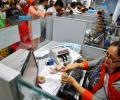
With deposit growth remaining sluggish and the credit - deposit ratio of commercial banks crossing 80 per cent, banks have ramped up their borrowing in the certificate of deposit (CD) market. In the fortnight ended November 14, CD issuances climbed to nearly Rs 55,000 crore - double the borrowings of the preceding two fortnights and the highest since the September 19 fortnight.
Uncertainties stemming from the West Asia crisis and its potential impact on inflation and economic growth were key factors in the Reserve Bank of India's Monetary Policy Committee (MPC) decision to maintain the status quo on interest rates, according to the recently released MPC meeting minutes.

Following through announcements with enforcement of measures is key, as a run through recent Indian economic history shows, points out A K Bhattacharya.

Unified Payments Interface (UPI) transactions reached a record high in March, driven by festivities and the financial year closure, according to the National Payments Corporation of India (NPCI).

S&P Global Ratings has increased India's GDP growth forecast for the next fiscal year to 7.1 per cent, citing private consumption, investment, and exports as key drivers. However, the agency also cautioned that the conflict in the Middle East could strain India's fiscal position due to higher energy prices.

Insights from behavioural economics suggest that an ambitious nudge can be effective if three conditions are met, points out Ram Singh Insights from behavioural economics suggest that an ambitious nudge can be effective if three conditions are met, points out Ram Singh, director, Delhi School of Economics.

'In India's case, an extended earnings slowdown accompanied by rich valuations have dimmed returns since late 2024.'

The Sri Lankan government attributes the sharp depreciation of the rupee against the US dollar to the ongoing conflict in West Asia, citing increased costs for essential imports like gas, fertiliser, and oil.

The Indian government is integrating artificial intelligence into the Crime and Criminal Tracking Network & Systems (CCTNS) 2.0 to enhance crime tracking, criminal profiling, and predictive policing across the country.

The amount involved in banking system frauds surged to Rs 21,515 crore in the first half of FY26, up 30 per cent from the same period last year, even as the number of frauds fell 2.8 times to 5,092.

India's forex reserves dropped by $6.925 billion to $695.355 billion during the week ended October 24, the RBI said on Friday.

BJD president Naveen Patnaik has requested Union Finance Minister Nirmala Sitharaman's intervention in a case where an Odisha tribal man was forced to exhume his sister's skeleton to prove her death to a rural bank. Patnaik seeks accountability for the incident, which has sparked public outrage.

The Indian rupee crashed to a record closing low against the US dollar due to rising global crude oil prices, a strengthening dollar, and geopolitical tensions in the Middle East.

'Policy consistency combined with timely and calibrated reforms are expected to ensure that India not only maintains macroeconomic stability, but also emerges as a globally competitive and inclusive economy.'

Pakistan's skewed foreign reserves got a major boost after Saudi Arabia pledged an additional $3 billion in deposits while extending its existing $5 billion facility for a further three years.
If Tata Sons is listed, the special veto rights of Tata Trusts, under Article 121A, may have to go away.

The pickup was driven partly by fresh corporate investment but more by higher working-capital demand.

Fixed deposits from nationalised banks delivered higher returns than equities, outperforming both inflation and stock market benchmarks.

The Supreme Court of India will hear a suo motu case concerning victims of digital arrest, a growing form of cybercrime where fraudsters impersonate officials to extort money from victims.
